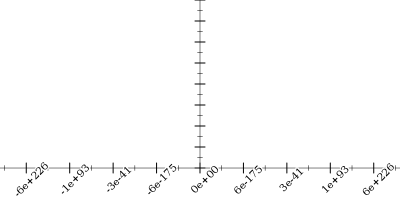
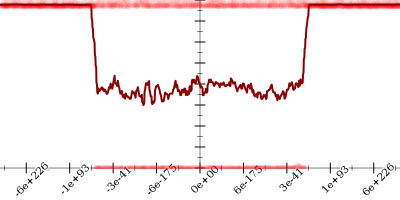
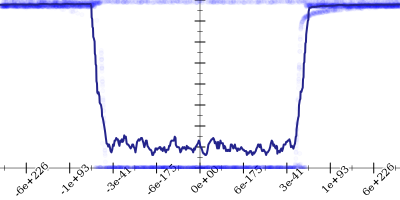
- Started with
\[(x * y + z)_* - \left(1 + \left(x \cdot y + z\right)\right)\]
44.5
- Using strategy
rm 44.5
- Applied flip-+ to get
\[(x * y + z)_* - \color{red}{\left(1 + \left(x \cdot y + z\right)\right)} \leadsto (x * y + z)_* - \color{blue}{\frac{{1}^2 - {\left(x \cdot y + z\right)}^2}{1 - \left(x \cdot y + z\right)}}\]
44.8
- Using strategy
rm 44.8
- Applied clear-num to get
\[(x * y + z)_* - \color{red}{\frac{{1}^2 - {\left(x \cdot y + z\right)}^2}{1 - \left(x \cdot y + z\right)}} \leadsto (x * y + z)_* - \color{blue}{\frac{1}{\frac{1 - \left(x \cdot y + z\right)}{{1}^2 - {\left(x \cdot y + z\right)}^2}}}\]
44.9
- Applied simplify to get
\[(x * y + z)_* - \frac{1}{\color{red}{\frac{1 - \left(x \cdot y + z\right)}{{1}^2 - {\left(x \cdot y + z\right)}^2}}} \leadsto (x * y + z)_* - \frac{1}{\color{blue}{\frac{1}{x \cdot y + \left(z + 1\right)} \cdot 1}}\]
44.6
- Applied taylor to get
\[(x * y + z)_* - \frac{1}{\frac{1}{x \cdot y + \left(z + 1\right)} \cdot 1} \leadsto (x * y + z)_* - \frac{1}{\frac{1}{y \cdot x + \left(1 + z\right)} \cdot 1}\]
44.6
- Taylor expanded around 0 to get
\[(x * y + z)_* - \frac{1}{\frac{1}{\color{red}{y \cdot x + \left(1 + z\right)}} \cdot 1} \leadsto (x * y + z)_* - \frac{1}{\frac{1}{\color{blue}{y \cdot x + \left(1 + z\right)}} \cdot 1}\]
44.6
- Applied simplify to get
\[\color{red}{(x * y + z)_* - \frac{1}{\frac{1}{y \cdot x + \left(1 + z\right)} \cdot 1}} \leadsto \color{blue}{\left((x * y + z)_* - y \cdot x\right) - \left(1 + z\right)}\]
33.4