\[(x * y + z)_* - \left(1 + \left(x \cdot y + z\right)\right)\]
Test:
simple fma test
Bits:
128 bits
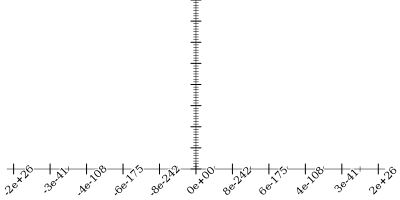
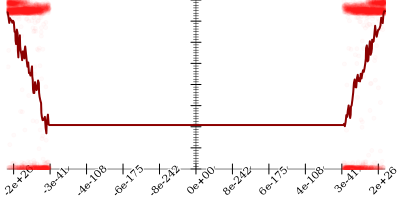
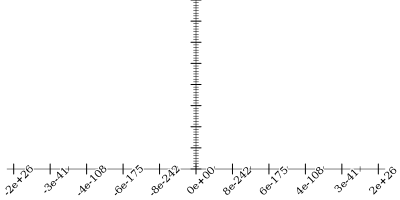
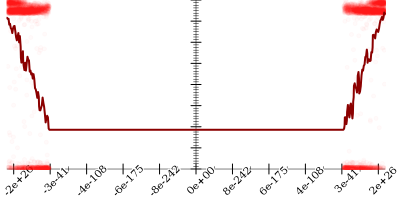
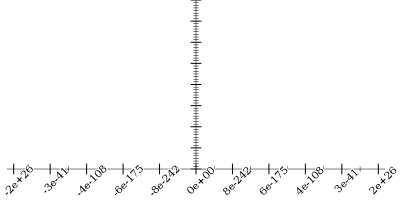
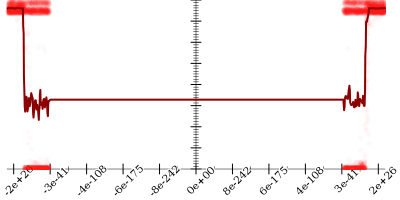
Bits error versus x
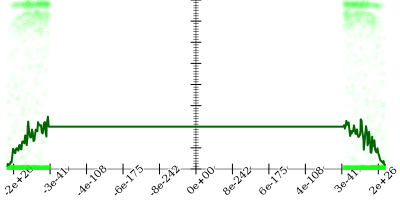
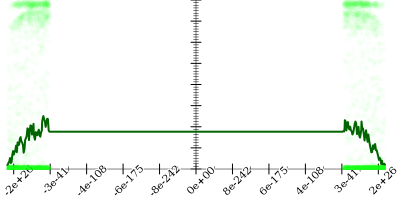
Bits error versus y
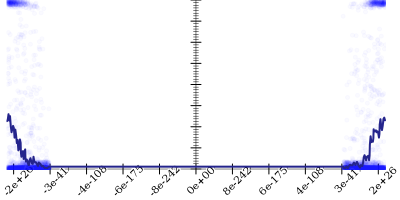
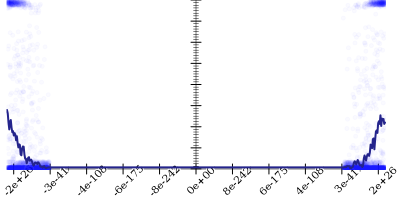
Bits error versus z
Time: 9.5 s
Input Error: 19.6
Output Error: 3.4
Log:
Profile: 🕒
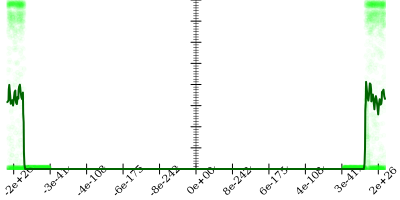
\(\begin{cases} (\left(\frac{-1}{x}\right) * \left(\frac{-1}{y}\right) + \left(\frac{-1}{z}\right))_* - 1 & \text{when } z \le -32602426.0f0 \\ \left((x * y + z)_* - y \cdot x\right) - \left(z + 1\right) & \text{when } z \le 161.79059f0 \\ (\left(\frac{-1}{x}\right) * \left(\frac{-1}{y}\right) + \left(\frac{-1}{z}\right))_* - 1 & \text{otherwise} \end{cases}\)

    if z < -32602426.0f0

    1. Started with
      \[(x * y + z)_* - \left(1 + \left(x \cdot y + z\right)\right)\]
      30.4
    2. Using strategy rm
      30.4
    3. Applied add-cube-cbrt to get
      \[(x * y + z)_* - \color{red}{\left(1 + \left(x \cdot y + z\right)\right)} \leadsto (x * y + z)_* - \color{blue}{{\left(\sqrt[3]{1 + \left(x \cdot y + z\right)}\right)}^3}\]
      30.1
    4. Applied taylor to get
      \[(x * y + z)_* - {\left(\sqrt[3]{1 + \left(x \cdot y + z\right)}\right)}^3 \leadsto (\left(\frac{-1}{x}\right) * \left(\frac{-1}{y}\right) + \left(\frac{-1}{z}\right))_* - 1\]
      0.2
    5. Taylor expanded around -inf to get
      \[\color{red}{(\left(\frac{-1}{x}\right) * \left(\frac{-1}{y}\right) + \left(\frac{-1}{z}\right))_* - 1} \leadsto \color{blue}{(\left(\frac{-1}{x}\right) * \left(\frac{-1}{y}\right) + \left(\frac{-1}{z}\right))_* - 1}\]
      0.2
    6. Applied simplify to get
      \[(\left(\frac{-1}{x}\right) * \left(\frac{-1}{y}\right) + \left(\frac{-1}{z}\right))_* - 1 \leadsto (\left(\frac{-1}{x}\right) * \left(\frac{-1}{y}\right) + \left(\frac{-1}{z}\right))_* - 1\]
      0.2

    7. Applied final simplification
    if -32602426.0f0 < z < 161.79059f0

    1. Started with
      \[(x * y + z)_* - \left(1 + \left(x \cdot y + z\right)\right)\]
      12.5
    2. Using strategy rm
      12.5
    3. Applied associate--r+ to get
      \[\color{red}{(x * y + z)_* - \left(1 + \left(x \cdot y + z\right)\right)} \leadsto \color{blue}{\left((x * y + z)_* - 1\right) - \left(x \cdot y + z\right)}\]
      9.6
    4. Using strategy rm
      9.6
    5. Applied add-log-exp to get
      \[\left((x * y + z)_* - 1\right) - \color{red}{\left(x \cdot y + z\right)} \leadsto \left((x * y + z)_* - 1\right) - \color{blue}{\log \left(e^{x \cdot y + z}\right)}\]
      15.6
    6. Applied add-log-exp to get
      \[\color{red}{\left((x * y + z)_* - 1\right)} - \log \left(e^{x \cdot y + z}\right) \leadsto \color{blue}{\log \left(e^{(x * y + z)_* - 1}\right)} - \log \left(e^{x \cdot y + z}\right)\]
      15.9
    7. Applied diff-log to get
      \[\color{red}{\log \left(e^{(x * y + z)_* - 1}\right) - \log \left(e^{x \cdot y + z}\right)} \leadsto \color{blue}{\log \left(\frac{e^{(x * y + z)_* - 1}}{e^{x \cdot y + z}}\right)}\]
      15.9
    8. Applied simplify to get
      \[\log \color{red}{\left(\frac{e^{(x * y + z)_* - 1}}{e^{x \cdot y + z}}\right)} \leadsto \log \color{blue}{\left(e^{\left((x * y + z)_* - \left(1 + z\right)\right) - y \cdot x}\right)}\]
      10.2
    9. Applied taylor to get
      \[\log \left(e^{\left((x * y + z)_* - \left(1 + z\right)\right) - y \cdot x}\right) \leadsto \log \left(e^{(x * y + z)_* - \left(y \cdot x + \left(1 + z\right)\right)}\right)\]
      12.5
    10. Taylor expanded around 0 to get
      \[\log \left(e^{\color{red}{(x * y + z)_* - \left(y \cdot x + \left(1 + z\right)\right)}}\right) \leadsto \log \left(e^{\color{blue}{(x * y + z)_* - \left(y \cdot x + \left(1 + z\right)\right)}}\right)\]
      12.5
    11. Applied simplify to get
      \[\log \left(e^{(x * y + z)_* - \left(y \cdot x + \left(1 + z\right)\right)}\right) \leadsto \left((x * y + z)_* - y \cdot x\right) - \left(z + 1\right)\]
      5.6

    12. Applied final simplification
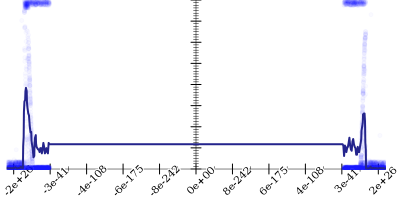
    if 161.79059f0 < z

    1. Started with
      \[(x * y + z)_* - \left(1 + \left(x \cdot y + z\right)\right)\]
      30.1
    2. Using strategy rm
      30.1
    3. Applied add-cube-cbrt to get
      \[(x * y + z)_* - \color{red}{\left(1 + \left(x \cdot y + z\right)\right)} \leadsto (x * y + z)_* - \color{blue}{{\left(\sqrt[3]{1 + \left(x \cdot y + z\right)}\right)}^3}\]
      29.9
    4. Applied taylor to get
      \[(x * y + z)_* - {\left(\sqrt[3]{1 + \left(x \cdot y + z\right)}\right)}^3 \leadsto (\left(\frac{-1}{x}\right) * \left(\frac{-1}{y}\right) + \left(\frac{-1}{z}\right))_* - 1\]
      0.2
    5. Taylor expanded around -inf to get
      \[\color{red}{(\left(\frac{-1}{x}\right) * \left(\frac{-1}{y}\right) + \left(\frac{-1}{z}\right))_* - 1} \leadsto \color{blue}{(\left(\frac{-1}{x}\right) * \left(\frac{-1}{y}\right) + \left(\frac{-1}{z}\right))_* - 1}\]
      0.2
    6. Applied simplify to get
      \[(\left(\frac{-1}{x}\right) * \left(\frac{-1}{y}\right) + \left(\frac{-1}{z}\right))_* - 1 \leadsto (\left(\frac{-1}{x}\right) * \left(\frac{-1}{y}\right) + \left(\frac{-1}{z}\right))_* - 1\]
      0.2

    7. Applied final simplification

  1. Removed slow pow expressions

Original test:


(lambda ((x default) (y default) (z default))
  #:name "simple fma test"
  (- (fma x y z) (+ 1 (+ (* x y) z)))
  #:target
  -1)