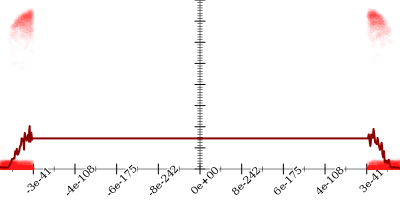
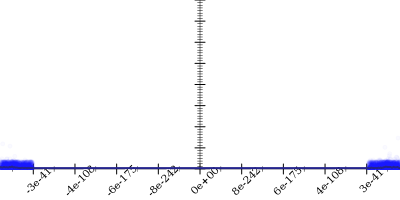
\(x.im \cdot \left(\left(x.im + x.re\right) \cdot \left(-x.im\right)\right) + \left(x.re \cdot x.im\right) \cdot \left(3 \cdot x.re + x.im\right)\)
- Started with
\[\left(x.re \cdot x.re - x.im \cdot x.im\right) \cdot x.im + \left(x.re \cdot x.im + x.im \cdot x.re\right) \cdot x.re\]
3.2
- Applied simplify to get
\[\color{red}{\left(x.re \cdot x.re - x.im \cdot x.im\right) \cdot x.im + \left(x.re \cdot x.im + x.im \cdot x.re\right) \cdot x.re} \leadsto \color{blue}{x.im \cdot \left(\left(x.re + x.re\right) \cdot x.re + \left(x.re + x.im\right) \cdot \left(x.re - x.im\right)\right)}\]
3.3
- Using strategy
rm 3.3
- Applied sub-neg to get
\[x.im \cdot \left(\left(x.re + x.re\right) \cdot x.re + \left(x.re + x.im\right) \cdot \color{red}{\left(x.re - x.im\right)}\right) \leadsto x.im \cdot \left(\left(x.re + x.re\right) \cdot x.re + \left(x.re + x.im\right) \cdot \color{blue}{\left(x.re + \left(-x.im\right)\right)}\right)\]
3.3
- Applied distribute-lft-in to get
\[x.im \cdot \left(\left(x.re + x.re\right) \cdot x.re + \color{red}{\left(x.re + x.im\right) \cdot \left(x.re + \left(-x.im\right)\right)}\right) \leadsto x.im \cdot \left(\left(x.re + x.re\right) \cdot x.re + \color{blue}{\left(\left(x.re + x.im\right) \cdot x.re + \left(x.re + x.im\right) \cdot \left(-x.im\right)\right)}\right)\]
3.3
- Applied associate-+r+ to get
\[x.im \cdot \color{red}{\left(\left(x.re + x.re\right) \cdot x.re + \left(\left(x.re + x.im\right) \cdot x.re + \left(x.re + x.im\right) \cdot \left(-x.im\right)\right)\right)} \leadsto x.im \cdot \color{blue}{\left(\left(\left(x.re + x.re\right) \cdot x.re + \left(x.re + x.im\right) \cdot x.re\right) + \left(x.re + x.im\right) \cdot \left(-x.im\right)\right)}\]
3.3
- Applied simplify to get
\[x.im \cdot \left(\color{red}{\left(\left(x.re + x.re\right) \cdot x.re + \left(x.re + x.im\right) \cdot x.re\right)} + \left(x.re + x.im\right) \cdot \left(-x.im\right)\right) \leadsto x.im \cdot \left(\color{blue}{\left(\left(x.im + x.re\right) + \left(x.re + x.re\right)\right) \cdot x.re} + \left(x.re + x.im\right) \cdot \left(-x.im\right)\right)\]
3.3
- Applied taylor to get
\[x.im \cdot \left(\left(\left(x.im + x.re\right) + \left(x.re + x.re\right)\right) \cdot x.re + \left(x.re + x.im\right) \cdot \left(-x.im\right)\right) \leadsto x.im \cdot \left(\left(x.im + 3 \cdot x.re\right) \cdot x.re + \left(x.re + x.im\right) \cdot \left(-x.im\right)\right)\]
3.3
- Taylor expanded around 0 to get
\[x.im \cdot \left(\color{red}{\left(x.im + 3 \cdot x.re\right)} \cdot x.re + \left(x.re + x.im\right) \cdot \left(-x.im\right)\right) \leadsto x.im \cdot \left(\color{blue}{\left(x.im + 3 \cdot x.re\right)} \cdot x.re + \left(x.re + x.im\right) \cdot \left(-x.im\right)\right)\]
3.3
- Applied simplify to get
\[x.im \cdot \left(\left(x.im + 3 \cdot x.re\right) \cdot x.re + \left(x.re + x.im\right) \cdot \left(-x.im\right)\right) \leadsto x.im \cdot \left(\left(x.im + x.re\right) \cdot \left(-x.im\right)\right) + \left(x.re \cdot x.im\right) \cdot \left(3 \cdot x.re + x.im\right)\]
0.3
- Applied final simplification